




Growing Opportunities in Grocery Stores
An Executive Voices Blog by Susie Jaramillo, CEO of Encantos Media Studios, PBC and the Creator of Canticos
When Toys “R” Us wound down in 2018, it liquidated 735 U.S. stores, including Toys “R” Us and Babies “R” Us locations. And in the eight years since, many have been asking the same question: outside Walmart, Target, and Amazon, where does a family actually buy a toy?
As the retail landscape evolved and the country’s demographics shifted, the shopping patterns of families have changed in response—and grocery stores have been stepping in to fill the void. But that doesn’t mean brand owners can simply take their existing retail strategy and apply it to grocery stores with no adaptations.
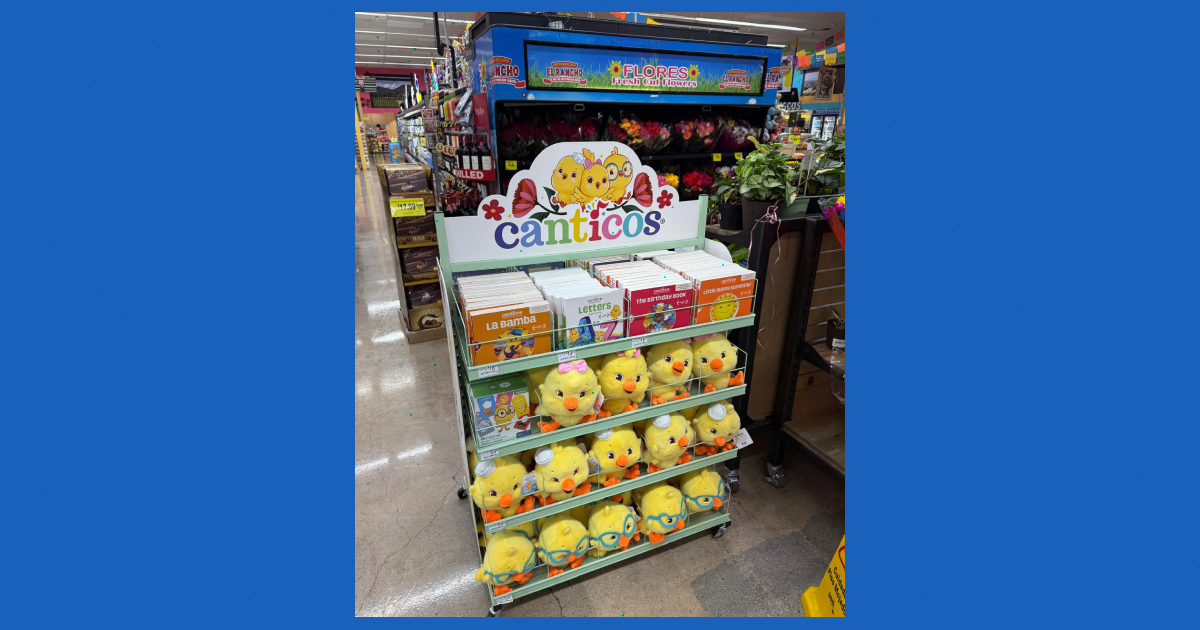
In the grocery stores we partner with, for example, our fixtures are on casters, and store managers move them to wherever works best. That means our product sits by the milk in one location but, in another, it is on a snack endcap between the Ritz and the Doritos. In a third store, it is at the front end under the balloons. I assumed that inconsistency was a problem we needed to solve. But, in a store where the whole trip is a family trip, there is no wrong aisle. Food is a weekly purchase. Apparel and toys are not.
Whatever else is true about where families shop, they are inside a grocery store more often than they are inside anything else.
Chedraui USA, a subsidiary of Mexico’s Grupo Comercial Chedraui, runs roughly 380 stores across California, Arizona, Nevada, New Mexico, and Texas under the El Super, Fiesta Mart, and Smart & Final banners. It is the fourth-largest grocer in California, and it spends $120 million on a distribution center in Rancho Cucamonga to support further growth. Heritage Grocers Group operates Cardenas, El Rancho, Tony’s Fresh Market, and Los Altos Ranch Market across six states, with a stated pipeline into Florida and New Mexico. And Food Bazaar has taken over space conventional grocers walked away from, including two former Fairway stores, and this spring paid $101 million to buy the land under one of its own Queens locations.
Set that expansion against retail as a whole. Coresight Research projects roughly 7,900 U.S. store closures this year against about 5,500 openings, following 8,270 closures in 2025. American retail is closing more stores than it opens.
By contrast, grocery chains are adding doors, buying real estate, and building distribution, all while Hispanic foods passed $40 billion in sales to become one of the fastest growing categories in the food business. These chains are thriving because they carry the products families want and speak their language at the register.
Circana found that more than a quarter of Gen Z and Gen Alpha consumers in the U.S. identify as Hispanic. And, between 2022 and 2023, Hispanic families accounted for 71% of the country’s population growth. That is not a segment. That is a meaningful share of American childhood, and it is concentrated in exactly the markets these grocers are building in.
But the licensing industry’s distribution plans haven’t caught up yet.
When we put plush products on grocery shelves and hold events in these stores, the room is never limited to mothers and infants. There are grandmothers on the floor, fathers holding babies, and older siblings sitting nearby. And the plush toys end up in the hands of both the eight-year-olds and the teenagers, because they are the ones who grew up on the songs. The baby is the reason the family came in but the older sister is the one who ultimately wants the toy.
Despite that growing engagement, there is a reason this channel still looks empty. For example, book sales in grocery stores largely don’t appear in Circana BookScan because these accounts aren’t in the reporting panel. Thousands of copies of our books move in stores that, on paper, sell no books at all.
The easy read here is that there’s cheap real estate in an overlooked format, but that read will cost somebody money. You have to be invited in, and you have to earn your place.
These retailers did not take our fixtures because a deck persuaded them. They took them because their shoppers were already asking, and because their buyers are looking for things that make a family trip to the grocery store feel like an occasion. A brand walks these retailers carrying whatever relationship it built beforehand, and a Spanish-language label on general-market IP is not a relationship.
A mother filmed herself walking her daughter through the doors of an El Rancho, captioned “on the hunt for Canticos.” It was shared close to a hundred times. Consider that the way a retailer would. She did not find the display while shopping—she made the trip to find the display, and as a result the store got her whole basket.
The demographics moved years ago, and the grocery stores followed. Most licensing distribution strategies still count doors in the formats shedding them, while another tier keeps opening, better capitalized than it looks and visited far more often, with the buyer and the influencer in the same cart.
And, ultimately, there is a grocery store within driving distance of nearly every major market in the country. Go stand in one on a Saturday and then look at your retail plan again.
Encantos Media Studios, PBC is an award-winning children’s entertainment and technology company. Named one of the World’s Most Innovative Companies by Fast Company, Encantos focuses on diverse stories and characters and brings them to life through apps, books, content, consumer products, and more. Its properties include the Emmy-nominated, 2x Kidscreen Award–winning preschool brand Canticos, the award-winning Tiny Travelers series, and the newly launched Skeletina.