
Sports Lifestyle Footwear Seeks New Fit
By Mark Seavy
Sports lifestyle footwear, with designs aimed more at comfort and fashion than running or training, is faced with excess inventory that has forced the industry to take new strides in collaborations.
The inventory is lodged in legacy styles and brands—including Nike, Converse, Adidas, Jordan, and others—and has resulted in retail discounts as suppliers forecast clearing the backlog by the second half of 2027.
The result has been sports footwear companies expanding beyond athlete-endorsed products with more fashionable designs to put a new spin on retro brands.
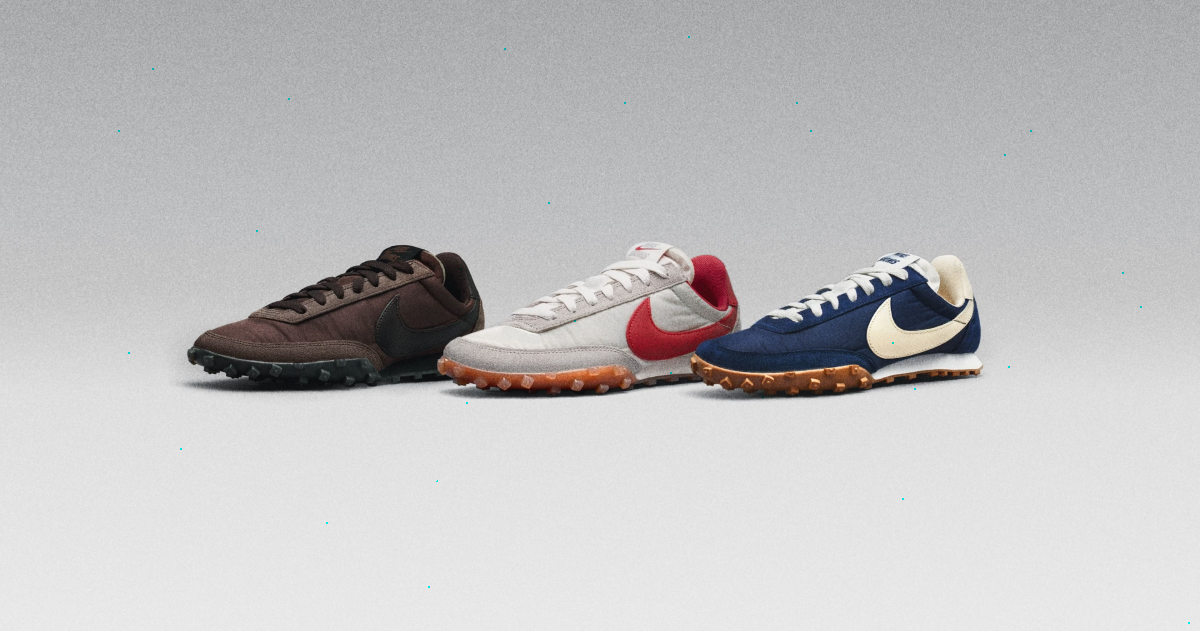
Nike, for example, combined its “waffle” design footwear (first introduced for running in 1974) with Kim Kardashian’s Skims brand. With the same outsole method as the more recent Waffle Trainer, the companies produced the NikeSKIMs Air Rift that is being released on November 17. Adidas, meanwhile, released a Gazelle collab with Japan-based Baycrew Group’s Spick and Span apparel brand earlier this year that later leant its design to the company’s Barreda Mary Jane shoes.
“Newness and innovation are blending into daily life and that is why we see the ballet and mary jane sneakers doing well,” said Jitong Li, Senior Analyst at the research firm Euromonitor. “Legacy styles are slowing down but there are some opportunities to slightly change the style and win in the future.”
That transition could be key in the $55-billion U.S. footwear market where “sports-inspired” styles total $17.4 billion, followed by outdoor styles at $5.4 billion, according to Euromonitor. And it comes at time when the U.S. market is forecast to post 4% sales growth this year, driven by higher prices (3.5%) fueled by higher raw materials, shipping, and other costs partly tied to tariffs and ongoing global conflict. Unit volume accounts for the remainder of the growth.
Overall, Nike is forecast to see its market share slip slightly to 8.4% (down from 8.6% a year earlier), while Adidas boosts its share to 5.3% (up from 5.1%), according to Euromonitor.
Evidence of promotional prices in sports lifestyle footwear can be found among discount retailers. Footwear sales at Ross Stores’ 355-store dd’s Discounts chain have increased 18% this year, followed by Ross’ 1,094 namesake locations and Burlington Stores’ 1,212 outlets with 17% and 13% gains, respectively, according to Euromonitor.
“The lifestyle footwear market is currently difficult, and you see a lot of discounts, which makes it hard to plan growth [in the category],” Adidas CEO Bjorn Gulden said. The company has a brand collaboration with Coca-Cola based on its Samba that launched in June and the original design of which was introduced in 1949. “That is why it is important to grow in the performance [running and training] footwear market. We should not panic because this will normalize again. The inventories in the total market will come down and when the supply is not higher than demand, the discounts will disappear.”
Yet discounts on legacy brands have resulted in some retailers shifting emphasis to brands and styles that are less subject to price promotions.
At Dick’s Sporting Goods, while sales of Nike’s Michael Jordan’s Air Force 1 shoes have “slowed significantly,” new styles like On’s Cloudtilt and Nike’s Mind have increased, Executive Chairman Ed Stack said. Dick’s also has “transitioned early” out of some styles and into Birkenstock, Deckers Brands’ Uggs, and VF Corp.’s Timberland, Stack said.
“There is an over-capacity issue with some legacy silhouettes and an under-capacity issue on some of these new shoes that have come out and really resonated with consumers,” Stack said. “There is an imbalance right now.”
And, as footwear companies navigate higher costs and excess inventory, they are also charting a manufacturing course that is less reliant on China.
While China accounted for 45.6% of global footwear production in 2019, that declined to 36.8% this year, according to Euromonitor. Manufacturing in Vietnam and Indonesia rose to 9.8% (up from 7.7%) and 9.6% (up from 8%), respectively, during the same period. In the case of the U.S., specifically, 40% of production comes from Vietnam followed by China (19%, down from 26% in 2019) and Indonesia (12%).
As companies seek to bring more manufacturing closer to their target markets in an effort to cut down on shipping costs, several regions stand to benefit. For example, Brazil has seen its global share of footwear production increase to 3.9% (up from 3% in 2019).
“Sports and comfort brands are catching the attention of fashion,” Li said “Sports is still the engine at 58% of the [global footwear] market, but [the gap] is narrowing. It is a gradual rotation from athletic to fashion, but forward players will add more fashion to their classic legacy footwear styles.”