



Surprise Hits Are Speeding Up the Licensing Pace
By Mark Seavy
The speed at which licensing agreements are struck—and product arrives at retail—is accelerating amid a flow of surprise hit films and television series.
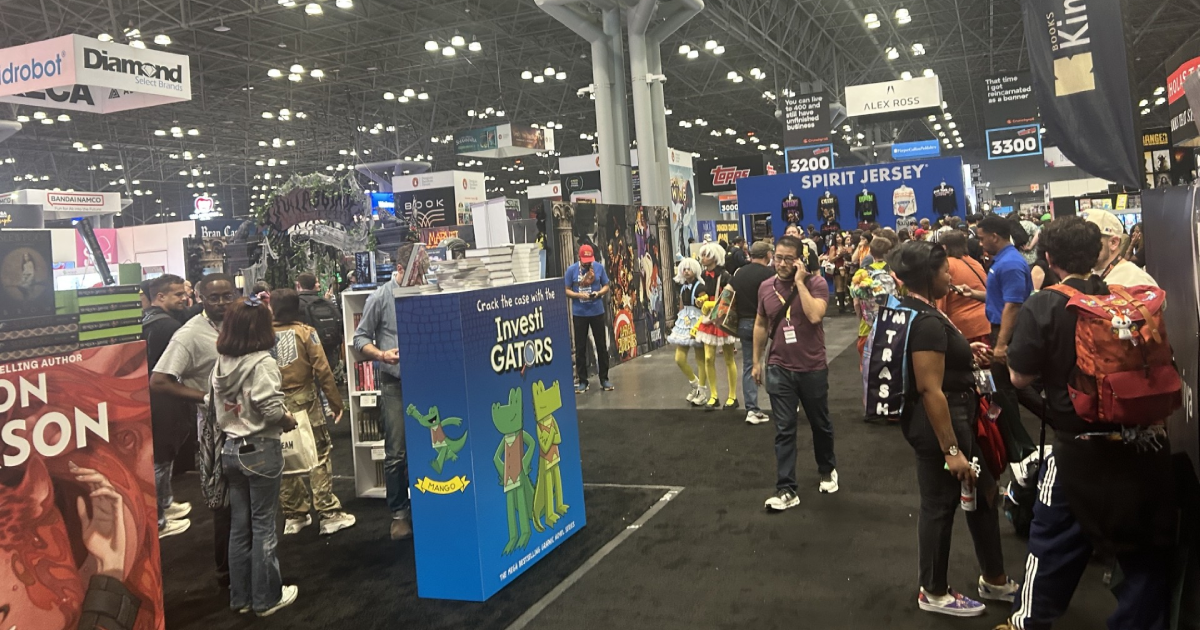
And though last week’s New York Comic Con (NYCC) showed that tentpole films (and the traditional assets that accompany them for brand licensing) aren’t going anywhere, the event also made it clear that sleeper hit independent films and streaming series are changing the distribution dynamics.
That shift follows horror film hits like Curry Barker’s Obsession, produced by Universal Pictures, and Kane Parsons’ Backrooms, distributed by A24 Entertainment, which were surprises at the box office but ultimately were slow to secure licensing deals.
And several streaming hits, including KPop Demon Hunters, Ted Lasso, and Stranger Things, went on to become licensing success stories when products launched many months after their release. In the case of Stranger Things, the series was released in 2016 but the bulk of licensed merchandise did not arrive until the following year. The same held true for Ted Lasso, which gained attention with its first season in 2020 but did not field a large product assortment until the following year.
In the case of Obsession, Funko had started to develop a Pop! figure featuring the Nikki Freeman character within two months of the film’s release in May. The company relied on social listening to gauge interest and then used trailers and press photos to create a non-licensed version before getting approval from Universal for the final product, said James Bischoff, VP for Licensing and Business Development at Funko. The finished Nikki product is expected to be delivered by December. Funko also has boosted Mondo to 30 licenses from four when it acquired the company in 2022, including a 6.75-inch Masters of the Universe Mer-Man figure introduced at NYCC.
There have been instances where companies were able to overcome traditional timelines in order to meet demand, however. For example, Spirit Halloween fielded products for KPop Demon Hunters just weeks after it exploded in popularity last summer. The Halloween retailer sped up production and launched costumes (Rumi, Mira, and Zoey) through its stores in October 2025 after the film was released on Netflix in the U.S. in June 2025.
“Back in the day, there was a style guide and you started talking about the property 14 months out [from release] and you would build up from there,” said Benjamin Butcher, a former Disney and Funko executive who founded Kaleidos Creative, which has introduced collectibles with its own IP and that of licensed artists though 250 Hot Topic and Box Lunch stores and 32 Newbury Comics outlets. “I do not think you have that as much anymore. The time for creating IP is smaller, everything is compressed, and you must be nimble.”
That need to be nimble is also being driven by shorter stays at retail, licensing industry executives said. While tentpole films once typically enjoyed a six-month run at retail for licensed products, that has since shrunk to 12-18 weeks.
In aligning with that change, VeeFriends has been “caught by how quickly you can move with licensing,” said Andy Krainak, President of VeeFriends, which has licensed its characters to Topps for trading cards. The company also released 22 issues of its comic book, including the most recent version featuring the new Gentle Giant character, and has collaborated with Authentic Brands Group’s Reebok and Jazwares’ Squishmallows.
To shorten the development cycle, VeeFriends is managing product sourcing itself. But other suppliers maintain that how quickly licensed products can be brought to market varies by licensor. VeeFriends also plans to launch fruit snacks in 2027 using its own sourcing network, CEO Gary Vaynerchuk said.
“There isn’t consistency [in terms of approvals],” said Sergio Godinho, U.S. General Manager and Chief Operating Officer for trading card supplier Kayou, which unveiled a licensing agreement for Rainbow Group’s Winx Club at NYCC and is readying its own Hari & Hacci plush pendants in expanding from deals with Feld Entertainment’s Monster Jam, Viz Media’s Naruto, Aniplex’s Demon Slayer, and Hasbro’s My Little Pony. “There definitely is more of an element of speed now, but I wouldn’t say it is faster because sometimes it takes forever [to finalize an agreement].”
But those agreements are ultimately coming together, with a number of new partnerships and line extensions seen at NYCC.
LEGO, for example, continued to build out its Batman line with two Batmobile-based building sets and an addition to its wall art line with a 1,849-piece Joker set that’s due January 1 and based on Detective Comics cover art first released in 2011. Marvel Comics, meanwhile, paired with Japanese publisher Kadokawa for five titles, including those featuring Deadpool, Iron Man, Spider-Gwen, Spider-Man, and Venom that combine Japan-set stories with manga adaptions. And NHS Inc.’s skateboard supplier Santa Cruz launched a blind bag collab with Pokémon that will pair boards and with 30 Pokémon trading card designs.
“It is all a game of energy, and we try to do as much as we can with as many partners as we can to gain attention,” Krainak said. “Every single week there is a new collaboration, and they conjure attention through their frequency. Other companies take a more curated approach.”