




VTubers Use Licensing to Expand Globally
By Mark Seavy
Virtual YouTubers (VTubers), digital creators that have long been popular across Asia, are making inroads in North America through licensing.
The creators, who employ animated virtual avatars instead of their real face by using a 3D model with motion capture, were first popularized in Japan in 2016 with the emergence of Kizuna AI. Kizuna became the first of many “virtual idols” that have developed rabid fan bases across streaming platforms like YouTube, TikTok, and Twitch.
In Asia, VTubers have spurred a wave of licensed merchandise that includes trading cards, apparel, and games that are administered by agencies like AnyColor Inc. (Nijisanji Division) and Cover Corp. (Hololive Productions). In fact, Cover Corp. has a portfolio of more than 80 creators while AnyColor Inc. represents 160 VTubers.
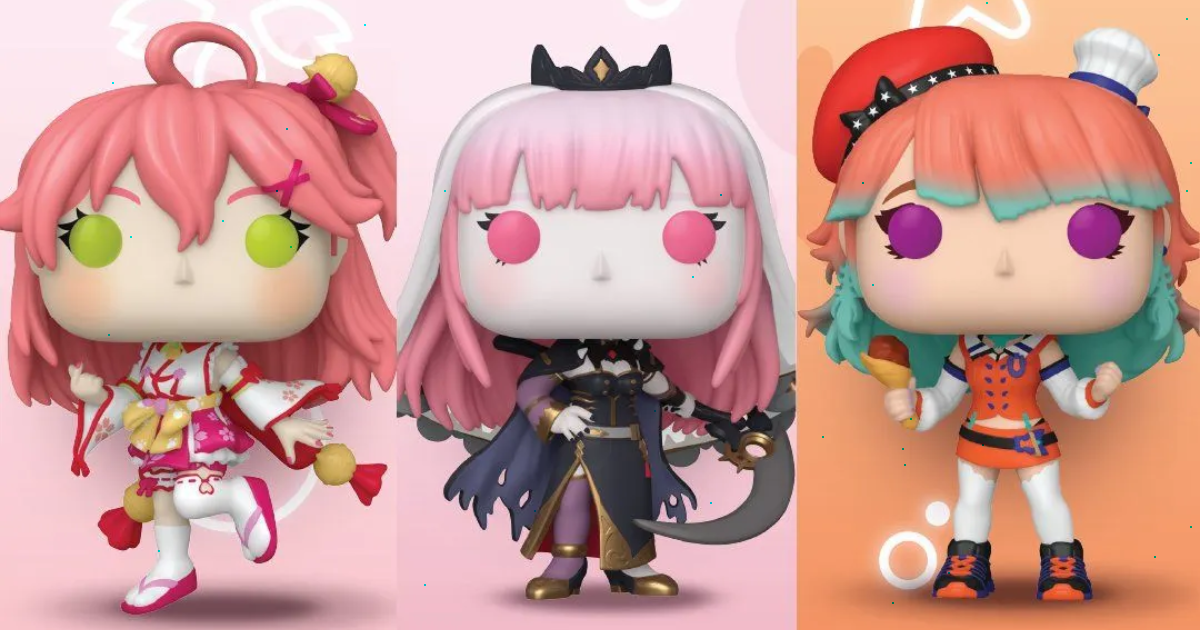
Despite its growing popularity, this phenomenon is only now reaching the licensing industry in North America, where the likes of Jakks Pacific and Funko have signed deals with Cover Corp. for several VTubers.
That includes Mori Calliope (2.61 million followers on YouTube), who has a deal with Funko for a 4.1-inch Vinyl Pop! Figure as well as an agreement with Taiwan’s We’s Star Ltd for MoriZakura liquor. Funko and Jakks are also fielding products for fellow VTubers Takanashi Kiara (1.6 million followers) and Sakura Miko (2.4 million followers).
While Funko’s initial vinyl figures are priced at $14.99, Jakks’ range will likely focus on premium and limited-edition figures that will retail for up to $50, said Jessica Kavanaugh, VP of Global Media and Advertising at Jakks. Additionally, Jakks has plans to field keychains and other items in the $11-$15 range.
These VTuber-inspired products, along with Jakks’ products in partnership with anime providers Aniplex, Crunchyroll, Kodansha and Viz Media, are part of a larger push to expand distribution as the toymaker moves to grow beyond its base in Walmart and Target and into specialty chains like Minioso and Pop Mart, Kavanaugh said. The first of these items will launch in spring 2027.
“Like toys, this can get there volume-wise, but it is not about putting a million plus units in the toy aisle and hoping it goes well,” Kavanaugh said. “There is a story to tell and not everyone knows what a VTuber is.”
Helping consumers around the world understand (and connect with) VTubers is a focus for agencies and manufacturers alike.
In Japan there are as many as 20,000 VTubers, around 1,000 of which are “notable” with a significant subscriber base. There are around 4,000 VTubers in the U.S., with agencies Hololive and VShojo representing many of them.
Among the most popular VTubers in the U.S. is Ironmouse, who is a fan of Toei Animation’s Sailor Moon and was born in Puerto Rico. Ironmouse debuted in 2017 and was represented by VShojo before shifting to United Talent Management in 2025. Ironmouse has 1.69 million subscribers on YouTube, 2.5 million subscribers on Twitch, and has signed licensing agreements with Jakks (plush, tech accessories, collectibles, cosplay), Moeflavor (apparel, lingerie, bikinis, head bands), and Razer (mice, headsets, gaming chairs).
“We want to make VTubers more a mainstream thing,” said Kazuma Hashimoto, a spokesperson for Hololive. “Right now, there hasn’t been that consensus [in the U.S.] that VTubers are entertainers that can sing, dance, and do live streams and have the same relationships [with fans] that other streamers have, but more toward an avatar.”
Amid its efforts to boost VTubers’ profile in North America, Cover Corp. is undergoing a reorganization. It disbanded a group of 12 male VTubers (Holostars) and several high-profile female VTubers (including Ceres Fauna, Amelia Watson, Sakamata Chloe, and Gawr Gura) announced their departures, raising questions about support structures for creators. In leaving the company, Gura cited both disagreements with management and creative burnout.
Cover took an $11.2-million charge for the reorganization in its fiscal year that ended March 31 and has responded by “strengthening” its talent management in building an “optimal support structure” for VTubers, including “periods of hiatuses and returns” and “reducing production burden,” CEO Motoaki Tanigo said in releasing earnings in May. Cover also took a $3.3-million charge to cover the shutdown of the Haloearth project, which will take effect on June 28. Haloearth was a metaverse and game designed to allow fans and VTubers to interact in a virtual space.
As part of the reorganization, Cover is planning to expand its touchpoints for fans. This includes a new store in Harajuku, Japan as well as a Secret Society holoX Live First Mission event that featured merchandise and a live concert by four VTubers that occurred on April 29 at Pia Arena in Kanagawa, Japan
Moving forward, industry analysts are optimistic about opportunities for VTubers to expand in markets like the U.S., which have largely remained untapped.
“In 2027, this [VTubers] will be all incremental revenue,” said Eric Beder, CEO and Senior Research Analyst at Small Cap Consumer Research. “The digital creator market will be a significant growth area and while it will not be highly material [revenue] the first year, it will be higher margin than what [toymakers] normally get.”