



Vending Machines Cash In with Licensing
By Mark Seavy
In the highly competitive vending machine business, companies are increasingly cashing in on IPs.
And while the vending industry is no stranger to selling licensed products (Topps was dispensing baseball cards in the 1950s), the scope of the business is broadening into a number of new categories.
The reasoning behind the strategy is relatively simple. Vending companies are seeking to stand out in locations where the machines tend to proliferate—including malls, airports, train stations, and other public places with high foot traffic. IP owners, meanwhile, are trying to broaden their audiences in what has become a crowded market.
These partnerships not only boost visibility and the potential for revenue but also meet evolving consumer expectations as demand for experiential retail continues to grow.
Japan tends to the lead way in vending machines, both with licensed consumer products and with food and beverages. Pokémon machines dispensing trading cards, snacks, collectibles, and other items have long been a fixture in the region and more than 1,400 of them have now been installed across U.S. states.
Successful versions are also available for Sanrio’s Hello Kitty (beauty products), Mattel’s Barbie (fashion accessories), Marvel Entertainment IPs (collectibles), and others. The attraction for fans is access to limited edition items, blind boxes, augmented reality experiences, and interactive features that can generate repeat purchases. The machines themselves often generate social media buzz.
“IP-licensed vending machines aren’t just selling products—they’re creating a whole new shopping experience,” said a spokesperson at the vending machine company Yoan. “Whether it is Pokémon, Disney, or anime brands, these machines turn everyday transactions into exciting moments. With smart strategies and the right locations, they can be a gamechanger in automated retail.”
A number of companies are looking to expand within the vending business using licensed IP. Chinese vending machine supplier Weimi, for example, produced a vending machine for a Ferrari model car licensee. It also produced machines carrying a mix of trading cards for Major League Baseball, the National Football League, the National Basketball Association, and Ultimate Fighting Championship.
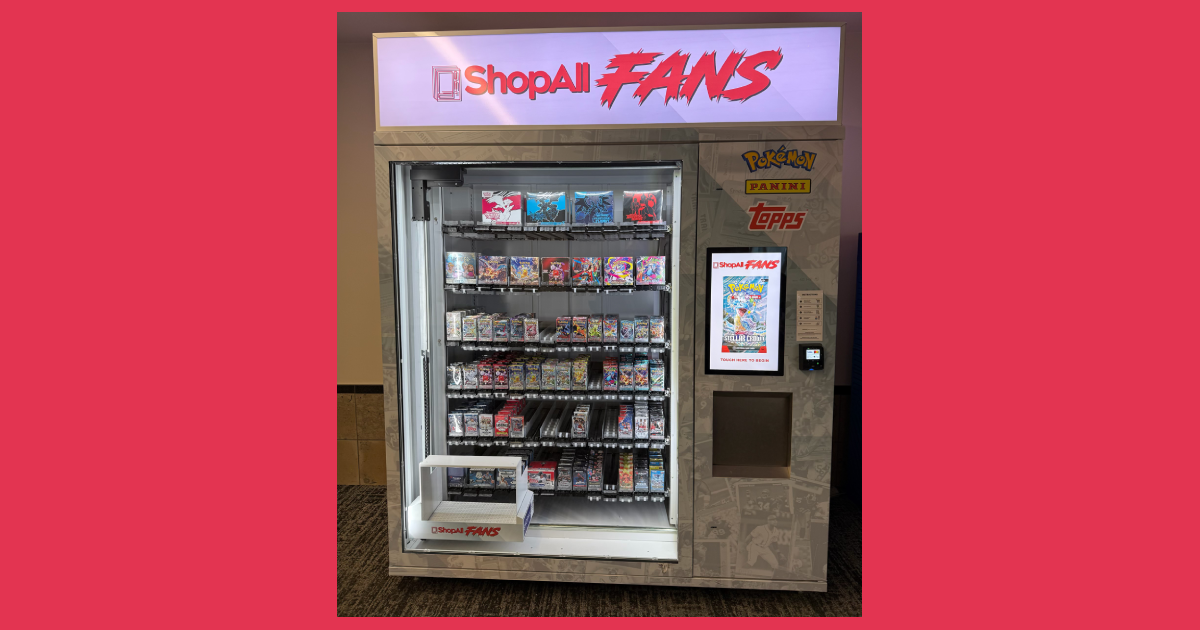
In the U.S., The Fan Stand has vending machines across 25 states, including at locations like the George Bush International Airport in Houston, TX and four ships from Royal Caribbean Cruises. The machines dispense sports trading cards as well as Pokémon cards in single packs (5-10 cards), blaster boxes (28), and larger mega boxes (40-80). Those different formats are important for collectors, as some 18,500 Pokémon cards have been released.
“The Fan Stand taps into nostalgia and culture in a way that feels both familiar and unexpected,” Linda Hurley, Director of Concessions at Houston Airports, told Sports Collectors Daily. “Whether you’re a die-hard collector or just need a quick gift, it’s a stop that makes the terminal experience a little more memorable.”
The lure of these brand-focused vending machines has not gone unnoticed. Machine operators typically get a return on their investment (machines cost upwards of $4,000) within 12-24 months, although it can be 6-12 months for more unique offerings, vending machine executives said. In a high-traffic area, the machines can generate $300-$500 in gross revenue per month. And with the expansion into some non-licensed categories like eggs in Japan, seafood in Australia, and French fries launched by Hot Foods Vending at a pickleball club in Columbus, OH, the market is expanding.
And in the case of trading cards, specifically, vending machines have also caught the attention of resellers.
For example, Pokémon machines in the U.S. recently turned into hotspots for resellers seeking to flip stock for profit. Entire machines were at times sold out in a matter of minutes. Pokémon responded by shutting down the machines in March 2025 for a software upgrade that set purchase limits and periodic inventory releases. In the case of the latter, the display sometimes might say sold out to prevent resellers from making multiple back-to-back purchases, according to the fan site Poké Beach.
“There is no doubt that vending machines are becoming a growing extension for retail as more product categories are added,” a licensing executive said. “And along with that popularity comes the resale market and then means to counteract abuses of it. These are signs of a growing category.”