



Licensing Expands Across Casino Gambling Formats
By Mark Seavy
Amid growing demand for gambling formats and titles, licensing is coming into play across slot machines, table games, iGaming, lotteries, and online social casinos.
And in an industry that cycles frequently between licensed games and internally developed titles, a number of IPs (including those across entertainment, celebrity, and board games) appeared to gain favor this week at the Global Gaming Expo in Las Vegas.
While the gambling landscape was heavy with licensed titles a decade ago, the industry shifted its emphasis to internally developed games for several years before returning more recently to third party IP-based offerings, said Andrea Cortez, Senior Director for Portfolio Strategy and Licensing at gambling supplier Light & Wonder (formerly Scientific Games).
Light & Wonder unveiled a Back to the Future slot machine at the show, having taken over a license previously held by International Gaming Technology (IGT), which first introduced the film IP to video slot machines in 2006. Light & Wonder, which also licenses across properties like Willy Wonka, Frankenstein, Dracula, Wizard of Oz, and other Warner Bros. IPs, balanced branded titles with the latest version of its proprietary Huff N Puff game across slot machines and iGaming.
“There has been an uptick again in licensed IP and a lot of it has to do with many manufacturers making the same variations of a popular internally developed game, which means you need licenses to differentiate yourself,” Cortez said. “It is all about having the right mix [between licensed and internally developed titles] in your portfolio so that you get that pop from a license rather than everything being the same.”
Evidence of a surge in licensed interest was easy to find across the Global Gaming Expo show floor.
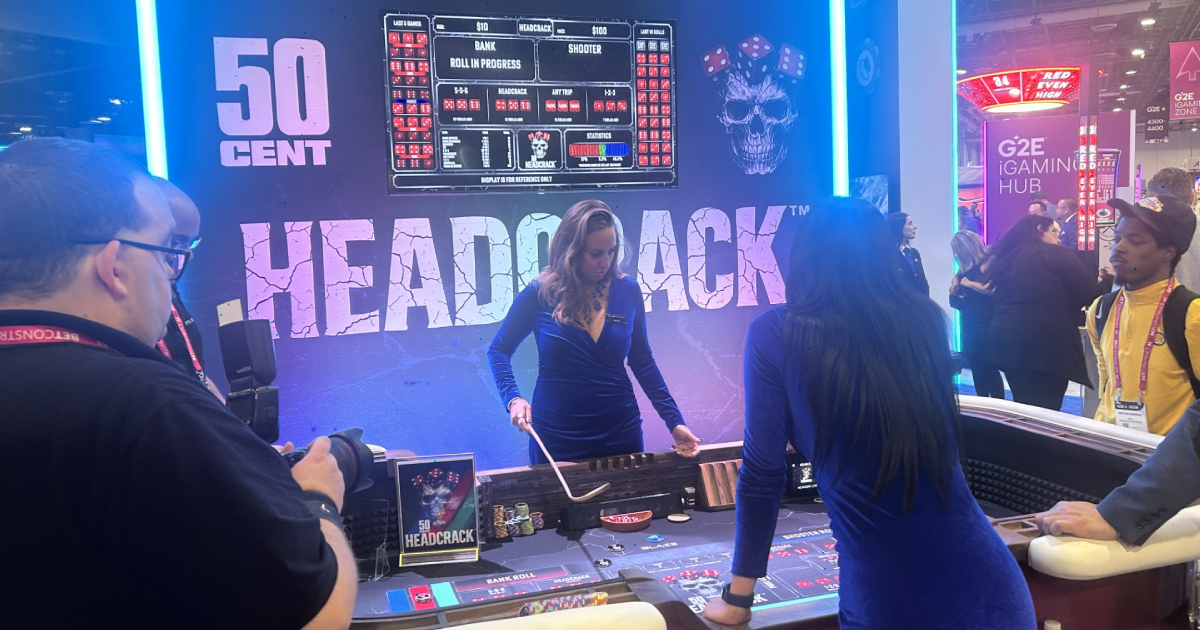
TCSJohnHuxley, a supplier of casino equipment like roulette wheels, blackjack and craps tables, and poker chip sorting machines, is launching a standardized table (blackjack, craps) version of the three-dice street game Cee-Lo featuring official dealers, standard betting structures, and published payouts. In doing so, TCSJohnHuxley partnered with rapper Curtis “50 Cent” Jackson in developing “Head Crack” for a market more accustomed to films and videogames.
In following a more traditional route to casinos, Galaxy Gaming is launching table game titles (blackjack, craps, baccarat) with Hasbro’s Monopoly, Battleship, and Yahtzee IPs, the latter having been installed at the Golden Nugget Casino in Las Vegas. Evolution (iGaming, including internet-based and live casino) and Aristocrat Technologies (slot machines) also partnered with Hasbro when the company expanded the number of its licensees to focus on different areas of expertise, said Claire Hunter Gregson, Senior Director of Business Development (Mobile & Casino) at Hasbro. Light & Wonder was previously the Monopoly licensee across multiple platforms for 27 years.
Many licensees attach brands to new hardware like slot machines to build a base of players, gaming industry executives said. A beloved brand could be the difference maker for a player in deciding whether or not they want to try an unfamiliar format.
While the industry’s focus has shifted to licensing for the time being, suppliers of these gaming machines also continue to work with design studios on proprietary titles such as Buffalo, Dragon Link, and Reign (Aristocrat); Huff N Puff (Light & Wonder); or 21+3 and Lucky Ladies (Galaxy Gaming).
And though some gaming executives argue that proprietary titles are a better bet given that they don’t require royalty payments and thus potentially can be developed at a lower cost, casino players are “more likely to play those games they are comfortable with” and spend 25% more on games whose brand they recognize, said Todd Haushalter, Chief Product Officer at Evolution Gaming.
Sometimes suppliers also turn to outbound licensing, such as Aristocrat partnering with Gaming Realms for the slingo (combination slots and bingo) version of its Buffalo and Mo Mummy titles. Galaxy Gaming licensed Ruby Seven Studios for social casinos (which do not offer betting with real money directly) for its 21+3 and Lucky Ladies titles. And Evolution licensed its Starburst online slots game to Gaming Arts for land-based casinos. Evolution also has an agreement with Galaxy Gaming for those titles in iGaming.
“We moved into the licensing space when the right title [Monopoly] became available and we never wanted to do it unless there was something that made sense for our customer base and had broad appeal,” said Phylicia Middleton, VP of Marketing at Galaxy Gaming, which deployed Monopoly Table Games Progressive at the Metropolitan Casino in London earlier this year. “It is balance of building our own content with our own brands and that is our bread and butter. Technology has allowed us to enhance visual experience. We have done that with in-house titles. But there are some brands like Monopoly that you can’t beat as far visual appeal and gaining attention. In-house titles and IP licenses have different enough lanes that we have not found a conflict.”