



Holiday Products Unwrap New Licensing Strategies
By Mark Seavy
Holiday products, which have historically been focused on tradition, are increasingly presenting a new take on licensing.
Candy canes, gingerbread houses, and advent calendars were once largely festooned with generic designs but are now being supplemented by candy, entertainment, beauty, and other brands. This shift comes as brand owners move to extend their reach and as consumers seek to connect with IPs in unexpected ways. Despite these changes, however, authenticity to the holiday season is still required.
“I look at these products as a way for a company to become more culturally relevant in their customer’s daily life,” Kirthi Kalyanam, Executive Director of the Retail Management Institute at the Leavey School of Business at Santa Clara University, told Modern Retail. “The customers are engaging and re-engaging with your product several times. The product must feel like it fits authentically within the holiday season.”
Spangler Candy Co., for example, is home to the Dum-Dums, Necco, and Bit-o-Honey brands and is a supplier of the traditional red and white peppermint-flavored candy canes. The latter continues to be a top-seller for Spangler during the holidays, but the company has also added candy canes inspired by Mars Wrigley’s Lifesaver and Skittles brands as well as Mondelez International’s Sour Patch Kids brand. Candy supplier Ferrara Candy Co.’s Brach’s brand, meanwhile, is fielding Keurig Dr. Pepper 7Up, A&W Root Beer, and Dr. Pepper versions.
And advent calendars, which traditionally provided a festive design behind 24 different doors in the run-up to Christmas Day, have since become a marketing bonanza for brands.
While those classic advent calendars are still fixtures of the holiday season, they are jockeying for shelf space with the likes of licensee Funko’s Five Nights at Freddy’s and Marvel versions, which are packed with 1.87-inch Pop! collectible figures behind every door. Additionally, Insight Edition has Wicked and My Hero Academia versions and the dual licensed Lego/Microsoft’s Minecraft model. There are also advent calendars stocked with licensed candy like Galerie Candy’s version with Hershey’s Kisses and chocolate bars.
At the higher end are department store Liberty London’s beauty advent calendar ($365), which started on a smaller scale in 2014 but has grown to include sample-size products from 30 brands, including Trish McEvoy’s lip color and Emma Lewisham’s face serum. Then there’s retailer Ulta Beauty’s Glam Cube makeup advent calendar ($149) and Sephora’s makeup and skin care version ($95).
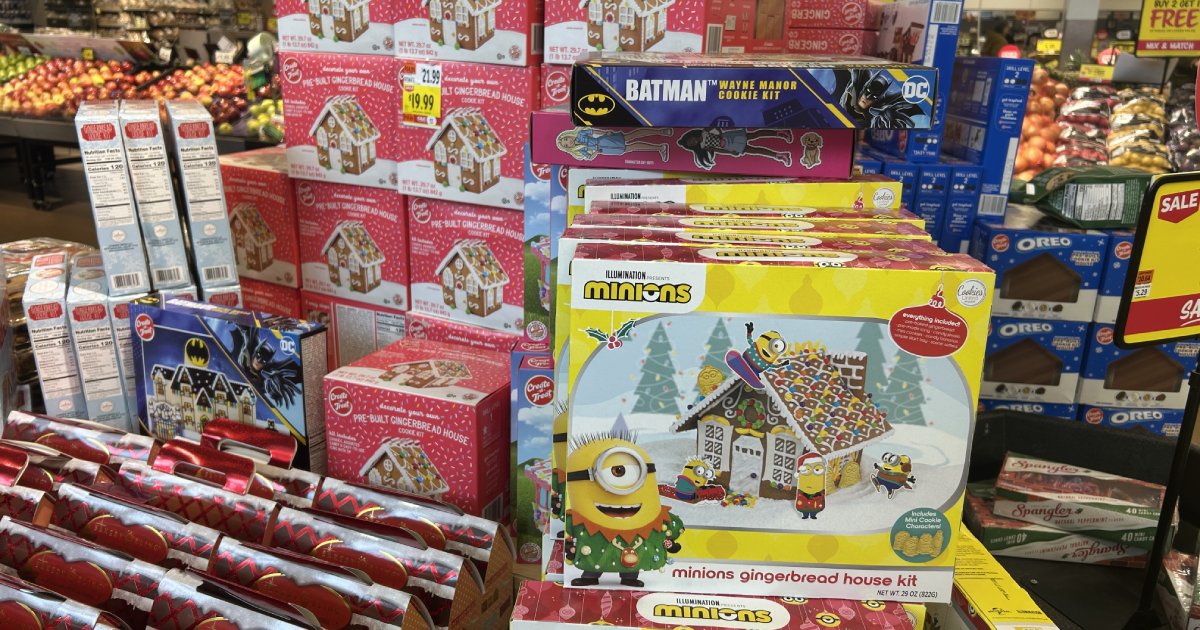
This focus on licensing also extends to gingerbread houses. The Northeastern U.S. regional grocery chain Stop & Shop featured a standalone display at the front of its stores with licensee Cookie United’s Minion’s Gingerbread House Kit alongside Brand Castle’s cookie version under the M&Ms brand. Pop culture chain Five Below, meanwhile, merchandised gingerbread kits toward the front of its stores with Give and Go Prepared Foods’ Hershey’s, Sour Patch Kids, and Minecraft mini house cookie kits.
But as more brands move into an expanded array of licensed holiday products, advent calendars remain a top prize given that consumers will engage with them every day for 24 days—even if only for a few moments, licensing executives said.
In the U.K., the research firm Ipsos found seven in 10 consumers in the region have at some point purchased an advent calendar. While most bought chocolate ones (84%), beauty calendars are increasing popular (15%), along with toy calendars (14%), and non-alcoholic food versions (10%). And discussions about buying those calendars often started in September, driven by retailer promotions and influencer-led unboxing videos.
“It’s really all about a further extension of fans wanting to ‘live the brand’ and further tighten that bond,” a licensing executive said. “From a brand standpoint, the deeper you can forge that connection, the better.”