



Combining Food and Fandom
By Mark Seavy
As restaurant and coffee chains find themselves competing with food retailers as consumers increasingly choose to dine in, licensing and collaborations as well as other limited-time promotions are being added to the menu.
It is not a total surprise, since consumers in tough economic times typically cut back on restaurant meals. But now, promotions that combine food with fandom are serving as social media fodder as well as culinary options.
Starbucks, for example, launched a collaboration with Authentic Brands Group’s Care Bears at its 611 locations in Taiwan that focuses as much on plush, tote bags, and other products as it does on coffee, with fans sharing their hauls across social media platforms like TikTok and Instagram. And other recent promotions launched by the coffee chain, including one tied to the recent film The Devil Wears Prada 2, have been available for a limited time or include a limited number of units in an effort to stoke excitement across social media.
And actor B.J. Novak’s (The Office) Chain, an “immersive dining” format, opened a limited-time food court stall with Mars Inc.’s Cheez-It brand in the Westfield Topanga mall in Canoga Park, CA. The menu will only be available in September and features three Cheez-It inspired food court staples, including a cinnamon roll, a Wagyu hot dog, and a cheesesteak. This promotion follows several other efforts Cheez-It previously launched, including a Studio Cheese nightclub and a Cheez-It Diner.
Additionally, Krispy Kreme linked up with Pokémon for a promotion that included six doughnuts inspired by characters like Pikachu and Charmander in celebration of the brand’s 30th anniversary. The offering spiked customer traffic 45% when it launched on August 18.
“The year is being defined by precision rather than broad-stroke expansion,” R. J. Hottovy, head of Placer.ai’s analytical research, wrote in a report. “The ‘rising tide’ era of post-pandemic growth is over; simply opening doors in high-growth Sunbelt markets or offering a generic discount is no longer enough to guarantee traffic. To succeed in this increasingly saturated and price-sensitive environment, operators must execute a delicate balancing act: aggressively defending their value proposition to fight off grocery competitors, while also reinvesting in the in-store experience to justify a visit.”
Lower-priced restaurant chains have been increasingly challenged by increased competition including food retailers like Trader Joe’s and Aldi; convenience stores like Wawa, Sheetz, Buc-ee’s, and Casey’s; and warehouse clubs like Costco and Sam’s Club. In fact, there has been gowth in the percentage of restaurant customers also visiting Aldi, according to Placer.AI.
And in working to pull more consumers away from quick-service and fast-food restaurants, retailers and their suppliers have responded with their own licensed offerings, collaborations, and promotions.
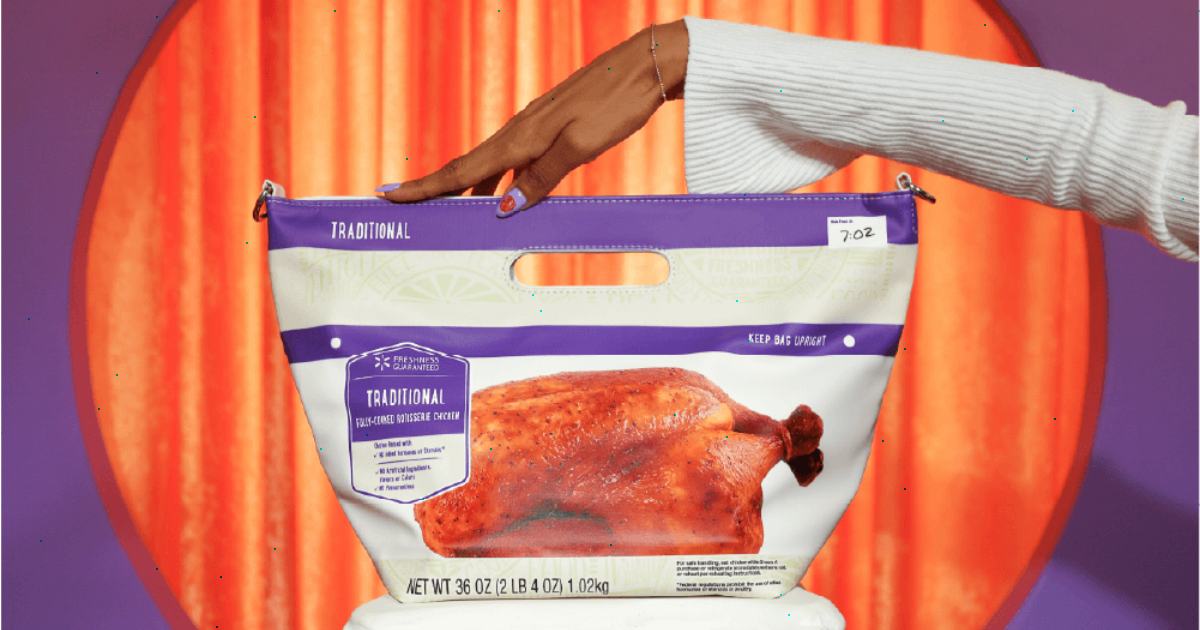
Walmart, for example, leaned into its rotisserie chicken, a staple that was introduced in the early 2000s and by 2006 was selling 100,000 units annually. The retailer took inspiration from the 2.4-pound chicken in a bag and turned it into a purse. The purse, which is available in two “flavors” (traditional and lemon pepper), is priced at $5.97, the same as the actual food product, which carried a $4.99 retail price in the early 2000s. In addition to a photo of the chicken, the bag also has the handle of the real product and a top zipper closure. It went on sale on September 1 on Walmart’s SparkShop.com and was listed as sold out a week later. Walmart also has two rotisserie charms to go with the purse.
And while at first blush a co-branding promotion pairing Sanrio’s Hello Kitty with Hormel Foods Corp.’s Spam brand may seem to be an out-of-the-box collaboration, there are several parallels. Hello Kitty has a long licensing history with everything from backpacks and toys to electronics and fashion, and the character carries across generations of consumers. Likewise, Spam has endured as a kitchen staple globally for years.
The centerpiece is a special-edition 12-ounce can of Spam’s 25% less sodium variety. The collectible label features Hello Kitty holding a Spam musubi, a popular Hawaiian snack made from a slice of grilled spam on a block of rice and wrapped in nori seaweed. The product has the familiar Spam flavor while offering reduced sodium compared to the classic version in keeping with the growing demand for healthier options. In addition to appealing to younger generations’ demand for healthier meals and snacks, the collaboration also evoke nostalgia, a trend that has swept nearly every category and proved attractive to Millennial and Gen Z consumers, in particular.