




Proven Franchises Take Center Stage at Licensing Expo
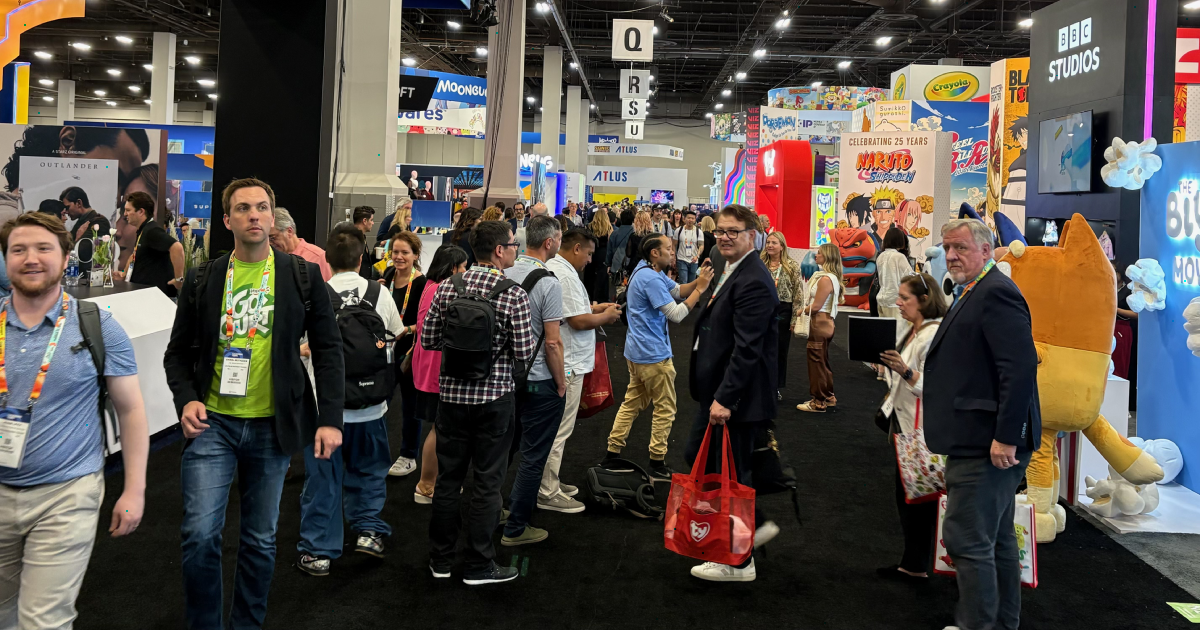
By Mark Seavy
As companies adjust their strategies in response to price increases and tighter consumer spending, fewer bets are being placed on new IPs and a heavier reliance on the tried-and-true is taking hold.
And while there may still be those surprise hits like last year’s KPop Demon Hunters, the emphasis at last week’s Licensing Expo in Las Vegas was on sequels, spinoffs, and less risk taking when it came to licensed IPs.
IVEST Consumer Partners’ Cloudco Entertainment, for example, is focusing on its successful Care Bears licensing program, which opened a play area at Barton Creek Square in Austin, TX with Simon Property Group earlier this year. At the same time, Cloudco is keeping its Holly Hobbie, Madballs, Tinpo, and Buddy Thunderstruck IPs in reserve, said Kristeen Tibbits, VP of Marketing at Cloudco. The company is also weighing additional play areas at Simon’s malls, she said.
Sony Pictures Entertainment, meanwhile, put promotional muscle behind well-known properties with upcoming film release dates including Jumanji 3 (December 2026), Legend of Zelda (April 2027), The Boys prequel spinoff Vought Rising (mid-2027), and Amazon Prime Video live-action series God of War (late 2027). And during its summit at Licensing Expo, Universal Pictures & Experiences highlighted Shrek 5 (June 2027) and Jurassic World 5, which is due in summer 2028.
Miraculous Corp. is spotlighting Miraculous: Tales of Lady Bug & Cat Noir and building out its business via a new toy licensing program (Jazwares) as well as experiential events. It has licensed Ground Control Entertainment for family entertainment centers (FECs) in the Middle East, starting with a formal opening at the Mall of Qatar in Doha in June. It also has plans for FECs in the U.S. as well as a live stage show with licensee Monlove that is expected to launch in 2027.
“The market seems very franchised out and there isn’t a lot of newness and creative opportunity. There are so many guardrails that require an IP to stay in a certain place and there is a lot more openness and creativity and speed-to-market with Japanese IP,” said Hazel Brown, a former Universal executive and now VP Retail Development and Brand Partnerships at Spiralcute, which is pushing to bring a dozen Japanese IPs (including Chiikawa and Mofusand) to the U.S. via the likes of Miniso and Urban Outfitters. Spiralcute has also added Jazwares as a master toy licensee.
Yet the reticence of major studios to take chances on new IPs is being matched by retailers, many of whom are reluctant to carry unproven properties, licensing executives said. That is partly due to the major purveyors of toys being Walmart, Target, and Amazon following the departure of Toys “R” Us, which once provided shelf space for new and unproven brands, the executives said.
“Buyers want to hear that you have a full package of support, end cap, and the right partners—and that it is a sure bet,” said Roz Nowicki, Global Head of Consumer Products at Miraculous. “Buyers are not rewarded for taking risks. You need to put together a full package for them because they want to make sure that 99 percent of what they get will sell through. That makes it much more challenging for newer brands trying to make their way to market and get placement with mass market retailers.”
That risk avoidant attitude caused many to initially pass on KPop Demon Hunters. When the animated film was released on Netflix in June 2025, there wasn’t a licensing program in place. This meant, when the film emerged as a hit and consumers started searching for licensed products, the streaming service, licensees, and retailers had to quickly pull together a strategy that started with Spirit Halloween sourcing costumes and later produced a joint master toy agreement between Hasbro and Mattel.
“KPop Demon Hunters didn’t test that well and Netflix didn’t initially invest much in licensing for it because they weren’t sure it was going to be a standout,” said David Born, Owner and Managing Director of Born Licensing, which represents IPs for licensing in advertisements and consumer products. “Netflix has recovered well but that is an example of retailers and licensees not wanting to jump on a property until it is proven and has low risk. For those with new IP, there is a hesitancy to buy into it until it is proven and when it proves itself, it is too late.”
New properties have also proven hard to find so far this year among the top grossing global box office films.
Licensing-friendly sequels like The Super Mario Galaxy Movie ($968 million in global box office) and The Devil Wears Prada 2 ($552 million) have been among the top performers so far this year, according to Box Office Mojo. And the new Star Wars film, The Mandalorian and Grogu, which was released in the U.S on May 22, was forecast to generate $82 million in box office revenue over the four-day period.
While much of the emphasis in the film and retails worlds has been on building or extending franchises, there were new trends on display at Licensing Expo—albeit on a smaller scale.
There were ducks, with Semk Holdings’ B. Duck, Ducks Unlimited, Twin Tiger USA’s DUCK-Y, and Numskull Designs’ Tubbz all vying for licensing attention. And Virtual YouTubers (VTubers) highlighted the motion capture and artificial intelligence (AI) technology that is being used by creators to develop digital avatars for concerts and other events. Toymaker Jakks Pacific is among the new licensees for Hololive’s stable of VTubers.