



Financial Forecasts Shift in the Toy Space
By Mark Seavy
Toy manufacturers offered shifting financial forecasts in releasing their quarterly earnings. These changes come in the face of fluctuating tariffs and ongoing global conflicts affecting the supply chain.
Because while tariffs appear to have stabilized recently, it is at higher rates that have forced toymakers to diversify production outside China. Additionally, closures related to the Strait of Hormuz have resulted in a sharp increase in the price of oil, a key component for the resin needed to make plastic for toys.
Mattel, for example, reported its retail inventories declined by a “low double digit” percentage in Q1 2026. According to CFO Paul Ruh, the toy industry was in a “healthy position” during the period and orders were stabilizing.
Jakks Pacific reported that retailers have operated with a degree of caution, with many “somewhat tentative” about the outlook for the year as they grow accustomed to volatility in the market, Jakks CEO Stephen Berman said.
Spin Master, meanwhile, expects the rise in oil prices that started shortly after the U.S. and Israel attacked Iran on February 28 to start impacting business in Q3 and Q4, CFO Jonathan Roiter said. The increase in oil prices, based on $100 per barrel, will boost production costs by $15 million for the year, he said. Oil contracts for 2027 will likely be based on current pricing, according to Roiter.
This variability in the market was reflected in the toymakers’ financial results.
Mattel reported a 4% rise ($862 million) in Q1 revenue, beating an earlier forecast, and projected a 3-6% increase in revenue for the year, Ruh said. Mattel posted a 15% increase in international sales and a 4% decline in North America.
Spin Master posted an 8.6% decline in Q1 revenue ($328.5 million) after retail orders surged in Q1 2025 in advance of the U.S. import tariffs that took effect in April 2025.
And while Jakks’ Q1 sales fell 16.1% in North America ($70.4 million) and 6% overall, ($100.1 million), it reported its best quarter in the Europe, Middle East, and Asia (EMEA) region since 2015 as sales rose 47.2% to $17.3 million, Berman said. The decline in Jakks’ Q1 revenue in North America came despite the release of The Super Mario Galaxy Movie, for which the company was a licensee.
“This year the [first] quarter faced, by far, the toughest operating comparisons in 2026, as domestic retailers shipped product early to offset the potential for material tariff increases [in 2025], and international players purchased product to capture demand driven by the Sonic 3 movie in 2025,” said Eric Beder, Founder and Head Analyst at Small Cap Consumer Research.
The potential for improved financials in the remaining balance of the year could be driven in part by a strong film release schedule with broad licensing programs.
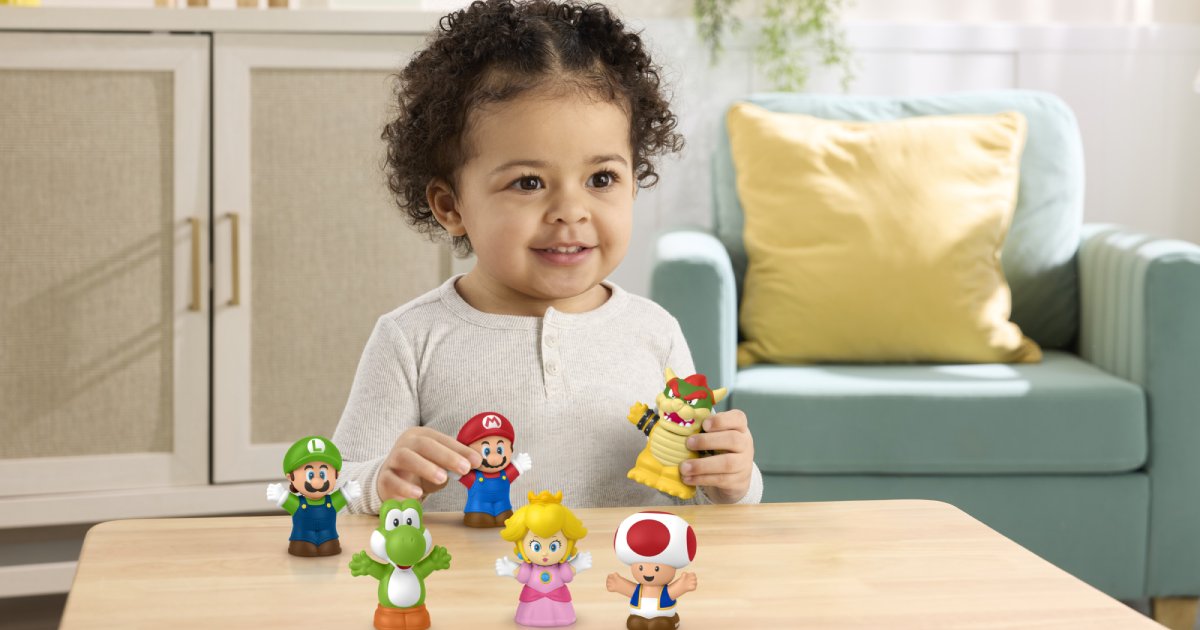
Mattel, for example, is releasing the Masters of the Universe movie with Amazon MGM Studios (June 5) and Matchbox: The Movie is due on Apple TV+ (October 9). Additionally, Mattel’s Fisher Price, which reported a 17% decline in Q1 sales, has licensing deals for its Little People brand with Nintendo and Disney (Toy Story, Mickey and Friends).
Spin Master posted strong sales of its Hatchin’ Yoshi toy tied to the Super Mario film, is a licensee for Toy Story 5, and produced Paw Patrol: The Dino Movie (August 14), which is being distributed by Paramount, company executives said. And Jakks is readying a licensed anime-related (Naruto, Attack on Titan, Demon Slayer) collection starting this fall and continuing into 2027.
Yet even with positive momentum around upcoming film releases, significant uncertainty remains throughout the toy industry as companies attempt to make long-terms plans despite not knowing how issues like tariffs or global conflicts might resolve. For example, many toymakers are optimistic about receiving tariff refunds following the U.S. Supreme Court decision in February striking down the levies, company executives said.
“We see minimal impact [from the ongoing conflict] on our business year-to-date,” Ruh said. “But it depends on how long the disruptions last and also how long the oil prices remain elevated.”